
Cetus Protocol (CETUS) kaufen
Kaufe Cetus Protocol einfach und sicher an einer der führenden europäischen Börsen.
Niedrige Handelsgebühren: 0,25 %
Kaufe Cetus Protocol mit PayPal, Kreditkarte und per Überweisung
Verwalte Cetus Protocol auf Bitvavo ganz einfach

* Bitte beachte, dass Kryptowährungen höchst volatil sind und die Investition in Kryptowährungen zu einem teilweisen oder vollständigen Verlust deiner investierten Beträge führen kann. Beurteile deine eigene Situation mit Bedacht, führe eigene Recherchen durch und investiere nur Geld in Kryptowährungen, dessen Verlust du finanziell tragen kannst. Die bisherige Performance ist kein Indikator für die zukünftige Performance.
400+
1,5+ Mio.
100+ Mrd.
4/5
Intuitive App
Lade unsere App herunter, um Kryptowährungen sofort von deinem Smartphone aus zu kaufen. Verwalte Kryptowährungen über dein Smartphone – jederzeit und überall.
Einhaltung Gesetzlicher Vorschriften
Bitvavo ist bei der niederländischen Zentralbank (De Nederlandsche Bank, DNB) und der niederländischen Handelskammer registriert und erfüllt alle geltenden Vorschriften.
Earn-Rewards
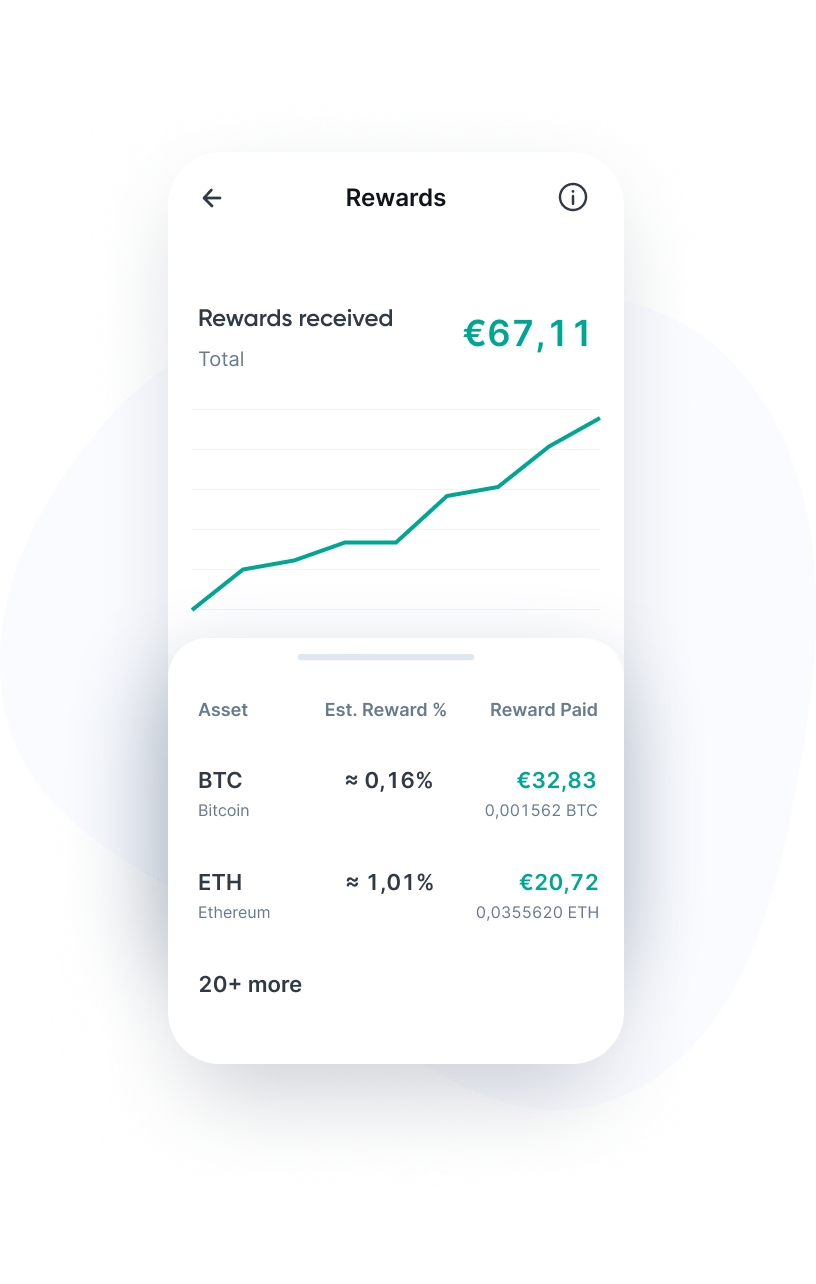
Bitvavo ermöglicht es dir, eine Rendite auf teilnahmeberechtigte Kryptowährungen zu erzielen. Finde aktuelle Renditesätze und weitere Informationen zu unseren Staking- und Lending-Services im Programm Verdienen.
Häufig gestellte Fragen
Bitvavo macht das Handeln mit Cetus Protocol so einfach wie möglich. Hier findest du Antworten auf einige der am häufigsten gestellten Fragen, die dir bei deinen ersten Schritten in der Welt der Kryptowährungen helfen.
Cetus Protocol is a decentralized exchange (DEX) and a protocol for concentrated liquidity, built on the Sui and Aptos blockchains. The goal of Cetus Protocol is to make trading within the DeFi space (decentralized finance) more efficient and user-friendly by providing a flexible and powerful liquidity network. The protocol offers both traders and liquidity providers an optimized experience through new technologies and models.
The unique aspect of Cetus is the implementation of the so-called Concentrated Liquidity Market Maker (CLMM) model, where liquidity providers (LPs) can concentrate their capital on specific price ranges where trading is active. This significantly increases capital efficiency because liquidity is provided only where it is actually needed. Unlike traditional AMM (Automated Market Maker) models, where liquidity is spread evenly across the entire price range, LPs in Cetus can strategically deploy their liquidity and thereby optimize their returns.
Cetus operates on the Sui and Aptos blockchains, which are known for their high speed and low latency, ensuring fast and efficient transactions. This makes the platform particularly suitable for DeFi users who demand quick and reliable trading experiences. The protocol enables developers to easily build their own products that leverage Cetus's liquidity, such as liquidity vaults, derivatives, and leveraged farming. This is supported by a Software Development Kit (SDK), allowing new projects to quickly integrate with Cetus's liquidity.
What makes Cetus special is the use of a dual token model, consisting of CETUS and xCETUS. This model contributes to long-term sustainability by rewarding users for their contributions to the network. CETUS is the primary token, while xCETUS functions as a liquid staking token (LST), allowing users to stake their CETUS and earn additional rewards.
Who founded Cetus Protocol?
Cetus Protocol was founded by Henry Du, an entrepreneur with experience in the blockchain and DeFi sectors. The team behind Cetus consists of experts in blockchain development, smart contracts, and liquidity systems. The company aims to push the boundaries of decentralized finance by providing innovative technologies and solutions. The team operates from a global network of developers and strategic partners, including LayerZero Labs and Fewcha Wallet, to accelerate the adoption and success of Cetus.
Cetus Protocol offers both end users and developers various functionalities that enhance trading and liquidity in the DeFi space. Some key applications include:
- Trading on a decentralized exchange (DEX): Users can securely trade assets without the intervention of a central authority.
- Liquidity provision: Users can allocate liquidity to specific price ranges and earn on transaction fees.
- Advanced trading strategies: Thanks to the CLMM model, users can execute more complex strategies, such as range orders and limit orders.
- Integration with other DeFi projects: Developers can leverage Cetus liquidity to build their own products, such as liquidity vaults and derivatives.
- Staking and rewards: By staking CETUS, users can obtain xCETUS and participate in loyalty programs.
Cetus Protocol utilizes advanced technologies to provide an efficient, secure, and flexible trading experience for DeFi users. The protocol operates on the Sui and Aptos blockchains, which are designed for high speed and low latency. This ensures that transactions are processed quickly and reliably, which is essential for the growth of the DeFi sector.
Concentrated liquidity market maker (CLMM)
Cetus applies the CLMM model, allowing liquidity providers to concentrate their capital in specific price ranges. This enables them to achieve higher returns by offering their liquidity only where it is actually needed. This contrasts with the traditional Automated Market Maker (AMM) model, where liquidity is distributed over a wide price range, often resulting in unused resources.
Within the CLMM system, LPs can take multiple positions in a single liquidity pool. Each position is linked to a specific price range. When the price falls outside this range, the associated liquidity becomes inactive and does not generate transaction fees until the price returns within the range. This provides LPs with the flexibility to adjust their strategies according to current market trends.
Double token model (CETUS and xCETUS)
The dual token model of Cetus is designed to ensure the long-term sustainability of the protocol. CETUS is the primary token of the platform, used for transactions and as a reward for liquidity providers. xCETUS is a liquid staking token (LST) that represents the staked CETUS. This system encourages users to stake their CETUS, which not only provides additional rewards but also contributes to the stability of the protocol.
Integration and composability
Cetus offers developers the ability to integrate the protocol's liquidity through the Cetus SDK. This allows new projects to easily create their own trading interfaces with direct access to Cetus liquidity. The composability of the protocol promotes collaboration with other DeFi projects, creating a comprehensive and robust ecosystem.
Thanks to this integration, developers can also create more complex products, such as derivatives and leveraged farming, which benefit from the high liquidity and efficiency of Cetus. This makes Cetus a key player in the DeFi space, simplifying access to liquidity and encouraging the development of new DeFi applications.
Security and decentralization
Cetus is fully decentralized and uses smart contracts to execute transactions automatically and without intermediaries. This enhances security for users, as there is no central authority with access to the funds. The underlying blockchains, Sui and Aptos, use advanced cryptographic techniques to ensure the integrity of transactions and prevent double spending.
The CETUS token plays a central role within the Cetus Protocol and serves various functions in the ecosystem. It is used as the primary currency for transactions on the platform, allowing users to provide liquidity, participate in trading activities, and utilize the staking mechanism. CETUS also offers rewards for active participation in the network, such as liquidity provision and staking.
The maximum supply of CETUS is 1 billion tokens. This limited supply helps maintain the token's value by preventing inflation. A large percentage of the tokens is reserved for staking rewards and liquidity programs, while other tokens are used for ecosystem development, partnerships, and strategic investments. The distribution of CETUS is as follows: 50% is allocated to the community, 20% goes to the team and founders, 15% is reserved for partnerships and ecosystem development, and the remaining 15% is used for the platform's treasury and strategic reserves.
Cetus also offers a liquid staking token, xCETUS, which allows users to stake their CETUS and receive additional rewards. This provides extra incentives to retain CETUS within the ecosystem, benefiting the liquidity and overall stability of the protocol.
Cetus Protocol distinguishes itself from other blockchain and DeFi projects through several unique features. Below are five characteristics that make the protocol unique:
- Concentrated Liquidity Market Maker (CLMM): This model allows liquidity providers to concentrate their capital on specific price ranges where trading is most active, resulting in higher returns and more efficient liquidity.
- Dual token model (CETUS and xCETUS): This model incentivizes users to stake CETUS instead of selling it, ensuring the long-term liquidity and stability of the protocol.
- Flexibility for developers: With the Cetus SDK, developers can easily integrate their own products, such as liquidity vaults, derivatives, and leveraged farming, facilitating the adoption of the platform.
- Sui and Aptos blockchains: The choice of Sui and Aptos leverages advanced technologies that are fast, scalable, and secure, offering users a faster and more reliable trading experience.
- Permissionless and programmable features: Cetus offers fully open access for both end users and developers, without requiring permission to set up new trading strategies or liquidity pools.
You can buy CETUS at Bitvavo, a platform for both beginner and experienced traders. Follow the steps below to buy CETUS:
- Log in to your Bitvavo account or sign up as a new user.
- Make a deposit by clicking "Deposit" and selecting a payment method.
- Visit the CETUS purchase page.
- Enter the desired amount in euros or specify how many CETUS tokens you want to purchase, and click "Buy now".
Looking to store your CETUS tokens securely? This can be easily done in your Bitvavo account, where most customer funds are kept in offline cold storage. Although our security measures are strict, we recommend providing extra protection by enabling two-factor authentication (2FA). This adds an additional layer of security by requiring an extra code along with your password when logging in.
If you choose to send your CETUS tokens to an external wallet, you can easily so via Bitvavo. First, verify the wallet address and then send the tokens to your external wallet. Most software and hardware wallets support the storage of CETUS, allowing your tokens to be safely kept outside the platform.
* Diese Angaben dienen nur der Information. Sie stellen keine Anlageberatung dar und sollten nicht als solche angesehen werden.
Direkte Euro-Überweisungen
Der Kauf von Kryptowährungen mit Euro war noch nie einfacher. Bitvavo unterstützt 8 Zahlungsmethoden, einschließlich SEPA für sofortige Überweisungen.
Zahlungsmöglichkeiten →Keine Wallet erforderlich
Bitvavo verwaltet deine Wallets und Kryptowährungen, damit du es nicht tun musst. Handle sicher mit Kryptowährungen – auch ohne jegliches technisches Wissen.
Währungsliste →Sicherheitsmaßnahmen
Sicherheit hat bei uns höchste Priorität. Erfahre mehr über die Sicherheitsmaßnahmen bei Bitvavo und die Vorkehrungen, die wir zur Sicherung deines Kontos und unserer Plattform treffen.
Sicherheitsmaßnahmen →Füge Cetus Protocol zu deinem Portfolio hinzu
Schließ dich den über eine Million Nutzern an, die Cetus Protocol bei Bitvavo kaufen und verkaufen.
Cetus Protocol kaufenAllgemein
Handel
Populär
Bitvavo B.V.
Das Trading mit Kryptowährungen birgt erhebliche Risiken. Kryptowährungen sind äußerst volatil und du kannst einen Teil oder den gesamten investierten Betrag verlieren. Die Informationen auf dieser Seite stellen keine Anlageberatung dar und sollten nicht als solche angesehen werden. Bitvavo B.V. ist gemäß der Verordnung (EU) 2023/1114 (MiCA) als Anbieter von Kryptowerte-Dienstleistungen von der Autoriteit Financiële Markten (AFM), Vijzelgracht 50, 1017 HS Amsterdam, zugelassen. Weitere Informationen findest du in unserer Risikoaufklärung.
Bitvavo ist bei der niederländischen Handelskammer unter der Nummer 68743424 registriert.