
Buy Qtum (QTUM)
Buy Qtum safely and easily at one of Europe's leading exchanges.
Low trading fees: 0.25%
Buy Qtum with 8 payment methods
Qtum wallet included

* Be aware that digital assets are highly volatile and investing in digital assets can lead to partial or total loss of your investment. Carefully assess your own situation, conduct your own research and only invest in digital assets with money you can lose. Past performance is no indication of future performance.
400+
1.5M+
100B+
4/5
Intuitive Mobile App
Download our mobile app to buy cryptocurrency instantly from your phone. Manage your digital assets from your phone anytime, anywhere.
Legal Compliance
Bitvavo is registered with De Nederlandsche Bank (DNB), the Dutch Chamber of Commerce, and complies with all relevant legislation.
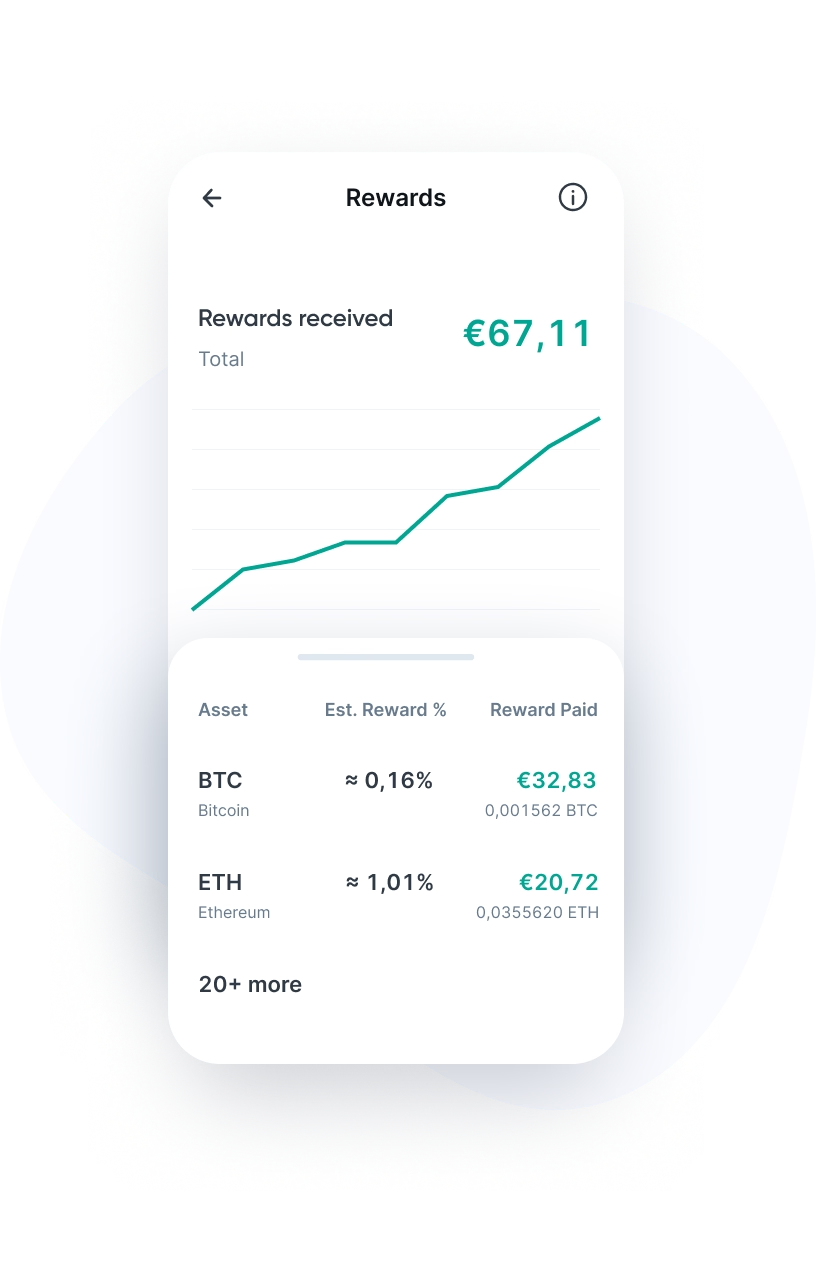
Earn Rewards
Bitvavo enables you to earn a return on eligible digital assets. Find current yield rates and more about our staking and lending services in the Earn program.
Frequently Asked Questions
Bitvavo makes Qtum as easy as possible. Here are answers to common questions to help you make your first steps in the world of digital assets.
Qtum, pronounced “Quantum,” is a cryptocurrency and blockchain platform that combines the best features of Bitcoin and Ethereum. The project is designed to unite the security of Bitcoin’s unspent transaction output (UTXO) model with Ethereum’s smart contract capabilities, providing a scalable and secure environment for decentralized applications (dApps), with a particular focus on enterprise applications in sectors such as finance and social media.
What sets Qtum apart from other blockchains is that it offers a solution for both developers and enterprise users. One of the key features of Qtum is its ease of use for large organizations. Enterprises can use blockchain technology to develop dApps that automate business processes. Thanks to the integration of smart contracts, these processes can be completely digital and without human intervention, reducing costs and increasing efficiency.
Qtum uses a Proof-of-Stake (PoS) consensus mechanism, meaning that new blocks are created based on the amount of tokens users stake, rather than through energy-intensive computations like Bitcoin. This model consumes significantly less energy and provides an accessible way to earn new coins. Additionally, Qtum users can vote on future network developments through staking, actively contributing to the governance of the network.
A unique innovation of Qtum is the Account Abstraction Layer (AAL). This layer acts as a bridge between the UTXO model and the smart contracts, allowing both technologies to work together seamlessly. This allows developers to benefit from the proven security of Bitcoin, while leveraging the flexibility of Ethereum.
QTUM is the native cryptocurrency of the Qtum ecosystem and has multiple functions. Users use QTUM to pay transaction fees, execute smart contracts, stake for rewards, and participate in the governance of the network. The maximum supply of QTUM is limited to 100 million tokens.
Who founded Qtum?
Qtum was founded in 2016 by Patrick Dai, Jordan Earls, and Neil Mahi. Patrick Dai has a background in computer science and has previously worked on major projects such as Alibaba. Jordan Earls is a prominent developer in the crypto space, with extensive experience in developing software for decentralized networks. Neil Mahi brings with him over 20 years of experience in software development and has worked on various blockchain projects. The Qtum platform is currently managed by the Qtum Foundation, a non-profit organization based in Singapore. The team consists of over 50 employees who focus on the further development and maintenance of the network.
Qtum offers several applications for both developers and end users:
- Smart contracts: Developers can create smart contracts that execute automatically without the need for a third party.
- Decentralized Apps (dApps): Users can build secure dApps that automate business processes, with applications in industries such as finance, logistics, and more.
- Staking: Using the Proof-of-Stake model, users can stake their tokens to validate new blocks and earn rewards, providing a low-barrier way to participate in the network.
- Business applications: Enterprises can use Qtum to implement blockchain solutions, such as for supply chain management and data verification, enabling them to improve and automate internal processes.
The core of Qtum’s technical operation is based on Bitcoin’s UTXO model. UTXO stands for “unspent transaction output” and acts as a ledger system where transactions are verified based on unused funds. This model provides a high level of security and prevents the same coins from being spent more than once. Qtum has integrated this technology to make transactions on the network safe and efficient.
Account Abstraction Layer (AAL)
One of the unique features of Qtum is the Account Abstraction Layer (AAL). This layer makes it possible to combine the UTXO model with smart contracts. This allows developers to leverage the security of Bitcoin while using Ethereum-like smart contracts. The AAL translates transactions, ensures the correct inclusion of information in the blockchain, and makes the process smooth and reliable.
Mutualized Proof-of-Stake (PoS) consensus mechanism
Unlike Bitcoin’s energy-intensive Proof-of-Work (PoW) system, Qtum uses the Mutualized Proof-of-Stake (MPoS) consensus mechanism to validate new blocks. In this model, blocks are created by users staking their QTUM tokens. Instead of miners using computing power, the rewards are split among multiple validators, increasing the security of the network and reducing the chance of attacks.
The more tokens a user stakes, the higher the chance they will be chosen to validate a block. This model is not only more energy efficient than PoW, but also provides an easier way to earn rewards through staking. Because rewards are distributed, many people see the MPoS model as a fairer system.
Smart contracts
Smart contracts on Qtum function similarly to those on Ethereum. Qtum’s virtual machine allows developers to build sophisticated applications that execute automatically when certain conditions are met. This makes Qtum an attractive choice for enterprise applications where automation and reliability are essential.
The QTUM token is the native cryptocurrency of the Qtum network and serves multiple functions. Users use QTUM to pay transaction fees and execute smart contracts. Additionally, the token is essential to the Proof-of-Stake (PoS) consensus model, where users stake their tokens to validate new blocks and earn rewards.
QTUM token holders also have voting rights within the network. They can vote on proposals for network upgrades or governance changes, with voting power proportional to the number of tokens they hold. This creates a decentralized and democratic governance system, allowing the community to influence the future of the project.
The maximum supply of QTUM tokens is capped at 100 million. Every four years, the amount of new QTUM tokens minted per block is halved. This deflationary effect limits the supply over time, which can support the value of existing tokens.
QTUM staking is an easy way for users to generate passive income. Users can stake their QTUM tokens using a wallet that supports staking. By staking these tokens, they contribute to the validation of new blocks and the security of the network.
To stake, users must store their tokens in an online wallet connected to the Qtum network. The more tokens a user stakes, the higher the chance they have of being selected to validate transactions and receive rewards. These rewards consist of newly minted QTUM and the transaction fees included in the validated block. Staking provides QTUM token holders with a passive way to earn additional income while supporting the network.
Qtum stands out for several unique features within the blockchain and crypto space:
- Account Abstraction Layer (AAL): This technology integrates Bitcoin's UTXO model with Ethereum-like smart contracts, making Qtum both flexible and secure.
- Mutualized Proof-of-Stake (MPoS): This consensus model distributes block rewards across multiple validators, increasing security and reducing the chance of attacks.
- Business focus: Qtum is specifically designed to support business applications. It enables businesses to work efficiently with blockchain technology by automating business processes.
- Staking and governance: Users can stake their QTUM tokens for rewards and participate in governance by voting on network developments, contributing to decentralized decision-making.
You can buy Qtum (QTUM) via Bitvavo. Our platform is suitable for novice or experienced traders. You can purchase QTUM via the website or mobile app by following these steps:
- Register an account or log in to your existing Bitvavo account.
- Make a deposit by clicking "Deposit".
- Go to the Qtum (QTUM) purchase page.
- Enter the amount in euros you want to invest or select the number of Qtum tokens you want to purchase and click "Buy".
How expensive Qtum is depends on the current market value. After purchase, the QTUM coins are automatically added to your Bitvavo account where you can easily manage, store or trade them. This way you can quickly respond to market fluctuations.
You can safely store your Qtum tokens in your Bitvavo account. The majority of funds are stored in secure cold storage, which ensures maximum security. For additional protection, we recommend enabling two-factor authentication (2FA). This adds an extra layer of security by requiring you to enter a unique code in addition to a password when logging in.
Prefer to store your Qtum tokens in an external wallet? No problem. Qtum is supported by various software and hardware wallets. First add the wallet address in your Bitvavo account before sending the tokens to an external wallet.
* This is for informational purposes only and is not advice, nor should it be relied upon as such.
Direct Euro Transfers
Buying digital assets with Euros has never been easier. Bitvavo supports 8 payment methods, including SEPA for instant transfers.
Funding Methods →No Wallet Needed
Bitvavo manages your wallets and digital assets so you don't have to. Trade digital assets safely without technical knowledge.
Asset List →Security Features
Security is our top priority. Explore our security options and the measures we take to keep your account and our platform safe.
Our Security →Add Qtum to your portfolio
Join over a million users buying and selling Qtum at Bitvavo and enjoy our low fees and easy to use platform.
Sign up & Buy QtumBitvavo B.V.
Trading digital assets involves significant risks. Digital assets are highly volatile and you may lose some or all of your investment. The information on this page does not constitute advice, and should not be relied upon as such. Bitvavo is authorized as a crypto-asset service provider under Regulation (EU) 2023/1114 (MiCA) by the Autoriteit Financiële Markten (AFM), Vijzelgracht 50, 1017 HS Amsterdam. More info can be found in our Risk Disclosure.
Bitvavo is registered at the Dutch Chamber of Commerce, number 68743424.