
Buy Livepeer (LPT)
Buy Livepeer safely and easily at one of Europe's leading exchanges.
Low trading fees: 0.25%
Buy Livepeer with 8 payment methods
Livepeer wallet included

* Be aware that digital assets are highly volatile and investing in digital assets can lead to partial or total loss of your investment. Carefully assess your own situation, conduct your own research and only invest in digital assets with money you can lose. Past performance is no indication of future performance.
400+
1.5M+
100B+
4/5
Intuitive Mobile App
Download our mobile app to buy cryptocurrency instantly from your phone. Manage your digital assets from your phone anytime, anywhere.
Legal Compliance
Bitvavo is registered with De Nederlandsche Bank (DNB), the Dutch Chamber of Commerce, and complies with all relevant legislation.
Earn Rewards
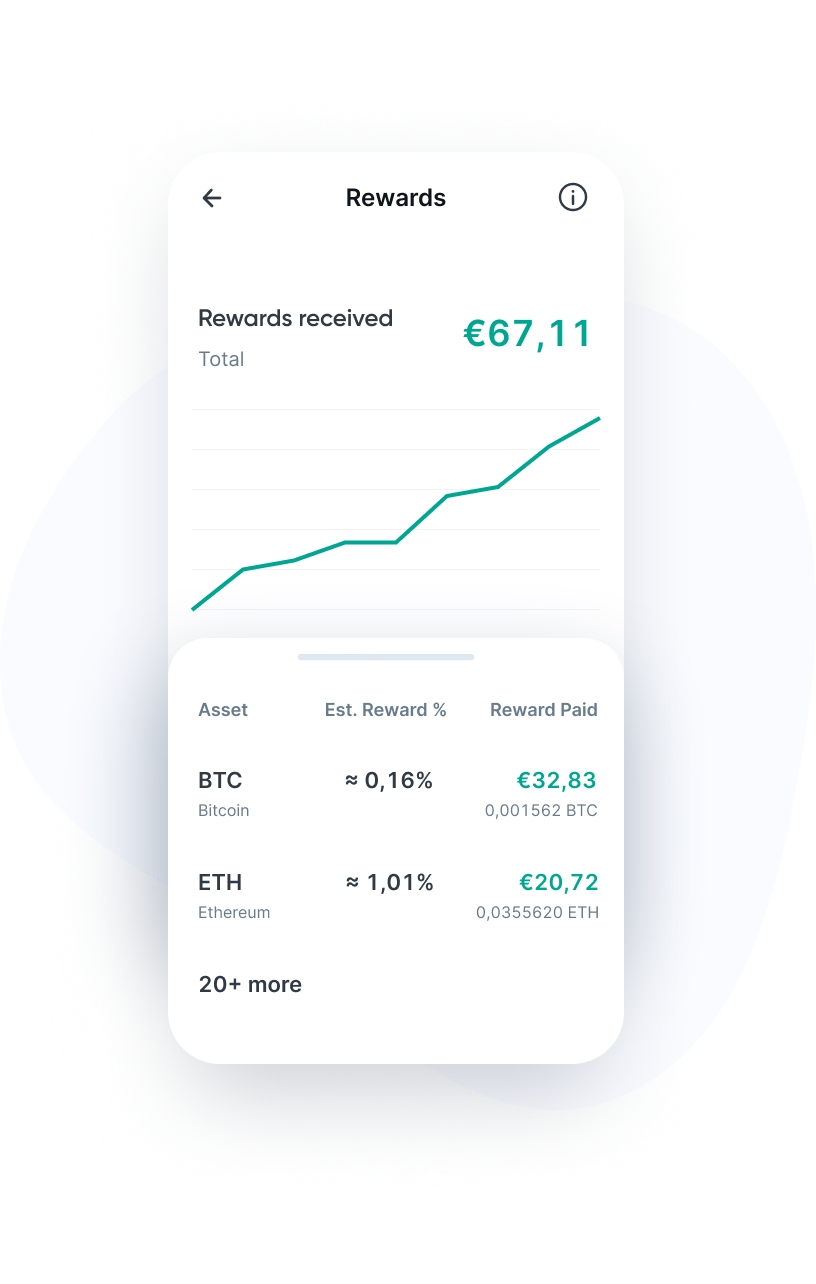
Bitvavo enables you to earn a return on eligible digital assets. Find current yield rates and more about our staking and lending services in the Earn program.
Frequently Asked Questions
Bitvavo makes Livepeer as easy as possible. Here are answers to common questions to help you make your first steps in the world of digital assets.
Livepeer (LPT) is a project on the Ethereum blockchain that provides a decentralized solution for video transcoding, a process of converting raw video files into formats that can be used across multiple devices and networks. Livepeer’s main goal is to make video transcoding easier and cheaper, which is especially important considering that video streaming accounts for up to 80% of global internet traffic.
Traditional video streaming services like YouTube and Twitch rely on centralized infrastructures to transcode and stream videos. This comes at a high cost, which is often passed on to users through advertising or the sale of user data. Livepeer addresses this problem by using a decentralized network of computers that offer their excess computing power for video transcoding.
App developers and video streamers are among Livepeer users who benefit from a scalable and cost-effective video streaming infrastructure. An example is a developer building a platform for live streaming of sports matches in schools. Thanks to Livepeer, they don’t have to worry about the technical aspects of video transcoding; this is handled automatically by the decentralized network.
The Livepeer Token (LPT) is used within the Livepeer ecosystem to secure the network and coordinate participants. Orchestrators are the ones who provide the computing power. They are required to stake LPT tokens to ensure their commitment and trustworthiness. Users can also become delegators by staking their LPT with a trusted orchestrator, in which case they receive a share of the rewards earned.
Who founded Livepeer?
Livepeer was founded in 2017 by Doug Petkanics and Eric Tang. Both founders have a background in technology and blockchain. Doug Petkanics previously worked at Hyperpublic and Wildcard, while Eric Tang has experience as CTO at multiple startups. The project is currently managed by Livepeer Inc., a company dedicated to the further development and growth of the Livepeer ecosystem.
As a decentralized video transcoding platform, Livepeer has various functionalities and use cases where it can be deployed:
- Live streaming: Developers can broadcast live events through Livepeer without high costs and complexity.
- On-demand video: The platform supports on-demand videos, as videos can be streamed quickly and efficiently.
- Decentralized Applications (dApps): Developers can integrate Livepeer into their dApps when looking for video solutions.
- Cost reduction: Businesses can use Livepeer's decentralized infrastructure to reduce their video transcoding costs.
- Earn money with content: Livepeer is an ideal platform for content creators who want to earn more money by cutting out the middlemen.
At the core of Livepeer’s technical operation are three nodes: broadcasters, orchestrators, and transcoders. Broadcasters are the ones who send video streams to the network for transcoding. The orchestrators then provide computing resources, such as CPU and GPU, to transcode the videos in exchange for a fee. The transcoders are the specialized hardware that ultimately performs the encoding and conversion of the videos.
Decentralized video transcoding
Converting video files into different formats to ensure compatibility with different devices and networks is done through a decentralized network of nodes.
Livepeer’s decentralized model offers several advantages. First, users are no longer dependent on large central companies and intermediaries, which means they remain in control of their own content. In addition to this independence, costs can also be significantly reduced. Another advantage is that decentralization makes it more difficult, or even impossible, for companies and governments to censor or remove content.
The role of orchestrators
Orchestrators need to stake LPT tokens to participate in the network. This acts as a guarantee that they will deliver quality work. If they do not perform as expected or make mistakes, they can lose (part of) their stake. Orchestrators distribute the work to transcoders and make sure that the videos are correctly encoded and sent back to the broadcasters.
Delegators and reward mechanism
LPT holders who do not wish to actively participate as an orchestrator or transcoder can stake their tokens with an orchestrator of their choice. In return, they receive a portion of the rewards earned by the orchestrator. This reward mechanism encourages participation and fair behavior within the network. It also provides a level playing field for everyone. Users who do not have the resources to set up an orchestrator themselves can still earn rewards by staking their stake on an existing orchestrator.
Consensus mechanism
Livepeer uses a two-layer consensus mechanism. The first layer is the Ethereum blockchain, where transactions are recorded. The second layer involves the distribution of new LPT tokens and the verification of the transcoding work. This is done via a Delegator Proof-of-Stake (DPoS) model, where orchestrators act as validators. They ensure the correct handling of payments, token distribution, and network security.
The Livepeer Token (LPT) plays an important role in the Livepeer ecosystem. First, LPT serves as a coordination mechanism. Orchestrators need to stake LPT to participate in the network and perform video transcoding. This stake serves as a guarantor and ensures that they act trustworthy and fair, otherwise they risk losing their staked tokens.
LPT is also used for rewards. Both orchestrators and delegators (who stake their LPT with orchestrators) earn rewards in the form of Ether (ETH) and newly minted LPT tokens, based on the size of their stake. This incentivizes active participation in the network.
At the end of each round, which lasts approximately 24 hours, new tokens are minted and distributed to active participants. The maximum supply is set at a certain number of LPT tokens.
To stake LPT, you first need to decide whether you want to become an orchestrator or stake your tokens as a delegator with an existing orchestrator. If you want to become an orchestrator, you will need to stake a minimum amount of LPT tokens to ensure your trustworthiness and commitment. This process involves setting up your computer or server to perform video transcoding and thus offer your services within the network.
If you prefer to stake as a delegator, you first choose a trusted orchestrator and stake your LPT tokens via the Livepeer Explorer or another supported wallet. In return, you receive a portion of the rewards earned by the orchestrator. This process is simpler than setting up your own orchestrator, which is why most users choose this form of Livepeer staking.
A number of features and characteristics make Livepeer a unique project within the crypto space:
- Decentralized video transcoding: By leveraging decentralized computing power, Livepeer provides a more cost-effective and efficient solution for video transcoding without relying on central services.
- Transcoding Cost Savings: Livepeer can reduce video transcoding costs by up to 50x, making Livepeer an attractive option for developers and video streamers.
- Pay-as-you-go model: Users only pay for the services they actually use, creating a fairer and more user-friendly economic structure.
- Censorship Resistant: Due to its decentralized nature, Livepeer is less susceptible to censorship and interference from companies and governments when it comes to media and video content.
- Revenue from unused computing power: Users have the opportunity to generate revenue by contributing unused computing power to Livepeer's network.
Want to buy Livepeer (LPT)? You can do so on the platform of Bitvavo, which is suitable for both novice and experienced traders. You follow the steps below to buy LPT tokens via our website or smartphone app:
- Log in to your Bitvavo account or create a new account.
- Deposit money into your account by clicking on "Deposit".
- Visit the Livepeer (LPT) buy page.
- Enter the amount in euros you want to spend or the number of LPT tokens you want to buy and click "Buy".
After purchase, your LPT tokens will be automatically added to your Bitvavo account, where you can easily manage and trade them. Selling LPT tokens is just as easy from your own account, so you can quickly respond to price and market changes.
You can safely store your LPT tokens in your Bitvavo account. Bitvavo keeps the majority of assets in cold storage, which means they are stored offline for extra security. We also recommend enabling two-factor authentication (2FA) as an extra layer of security for your account.
Do you prefer to keep full control over your cryptocurrencies? After purchase, you can easily transfer the LPT tokens to an external wallet by linking the wallet address to your Bitvavo account. Most software and hardware wallets support Livepeer tokens.
* This is for informational purposes only and is not advice, nor should it be relied upon as such.
Direct Euro Transfers
Buying digital assets with Euros has never been easier. Bitvavo supports 8 payment methods, including SEPA for instant transfers.
Funding Methods →No Wallet Needed
Bitvavo manages your wallets and digital assets so you don't have to. Trade digital assets safely without technical knowledge.
Asset List →Security Features
Security is our top priority. Explore our security options and the measures we take to keep your account and our platform safe.
Our Security →Add Livepeer to your portfolio
Join over a million users buying and selling Livepeer at Bitvavo and enjoy our low fees and easy to use platform.
Sign up & Buy LivepeerBitvavo B.V.
Trading digital assets involves significant risks. Digital assets are highly volatile and you may lose some or all of your investment. The information on this page does not constitute advice, and should not be relied upon as such. Bitvavo is authorized as a crypto-asset service provider under Regulation (EU) 2023/1114 (MiCA) by the Autoriteit Financiële Markten (AFM), Vijzelgracht 50, 1017 HS Amsterdam. More info can be found in our Risk Disclosure.
Bitvavo is registered at the Dutch Chamber of Commerce, number 68743424.